Design Industrial VR Training Around the Moment of Choice
In a high-risk workplace, knowing a procedure is not the same as being ready to use it. Readiness appears in the moment when a worker notices an abnormal condition, interprets incomplete information, chooses a response, and communicates what happens next. Effective vr training should be designed around that moment of choice—not around the amount of content a program can display. When practice reflects the decisions employees must make, immersive training becomes a practical bridge between written procedures and dependable performance.
Start with the decision, not the technology
Organizations often begin by asking which headset, platform, or visual style they should use. A stronger starting point is the operational decision the workforce must perform consistently. That decision may involve recognizing a gas leak, selecting an emergency route, isolating energy, responding to a fire, or stopping work when conditions move beyond a safe boundary.
Before a scenario is built, safety and operations leaders should define the hazard, the first observable cue, the decision that follows, the required sequence, and the escalation point. They should also identify the people involved, the information available under pressure, and the consequences of delay or incorrect action. Noise, restricted visibility, unfamiliar layouts, shift conditions, and communication barriers can all influence performance.
This needs-based approach keeps industrial safety training connected to the actual job. Subject-matter experts establish the operational truth, while instructional designers turn that truth into a focused experience with clear objectives. The result is more useful than a generic tour because the learner must interpret conditions and act within a realistic context.
Build a scenario that makes judgment visible
A strong vr simulation does more than place a learner inside a digital facility. It creates a sequence in which observation leads to interpretation, interpretation leads to action, and action changes what happens next. This structure gives instructors and learners something concrete to review.
A practical scenario can be organized into five stages:
- Orientation: Explain the objective, controls, roles, boundaries, and how to pause or request support.
- Recognition: Introduce cues such as an alarm, unusual equipment sound, visible vapor, a spill, smoke, or an unsafe position.
- Decision: Require the learner to choose an action, route, tool, communication, or sequence rather than simply select “next.”
- Consequence: Show how the situation develops. A sound response should stabilize or advance the scenario; an unsafe response should create a clear learning moment.
- Debrief: Connect the learner’s decision to the applicable procedure, emergency plan, role expectation, or supervisor coaching.
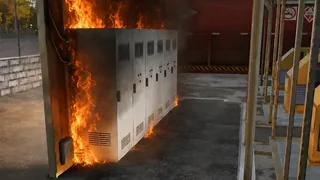
The consequence stage is particularly valuable for rare or dangerous events that cannot be safely recreated on demand. TrainBeyond’s published industrial materials describe customizable oil and gas scenarios involving fire, H2S leaks, and oil spills. The instructional value of these scenarios is not visual realism alone. It is the opportunity to practice recognition, communication, escalation, and the decision to stop before a real event demands those behaviors.
Turn completion into a practice cycle
Completion is a record of exposure, not proof of readiness. A more effective program gives employees structured opportunities to attempt, review, and repeat the skill. Each repetition should have a purpose rather than simply replaying the same content.
- Baseline: Let the learner respond with minimal assistance so current behavior becomes visible.
- Guided practice: Add prompts at critical moments and explain why the expected response matters.
- Independent performance: Reduce support and assess the execution against defined criteria.
- Controlled variation: Change a meaningful condition such as visibility, equipment status, hazard type, role, or communication demand.
- Workplace transfer: Review the current standard operating procedure and discuss how the practice applies to the employee’s actual area.
This cycle also supports different delivery models. A focused individual activity may help a new user build confidence, while a facilitated group session can examine team communication and role coordination. TrainBeyond’s published guidance describes complete sessions that include check-in, equipment preparation, immersive practice, and review, with the central practice portion adjusted to the learner and objective. The right duration is the one that preserves attention and creates enough repetition to improve performance.
Design comfort and access into the experience
Usability is part of instructional quality. If learners are distracted by discomfort, unsure how to move, or concerned about making the equipment work, the scenario cannot reveal their real decision-making. Organizations should provide an obstacle-free area, supervision, a simple orientation, and clear instructions for moving, interacting, pausing, and requesting help.
Designers should avoid unnecessary movement, disorienting effects, and visual complexity that does not support the objective. Participants should be monitored throughout the activity, with breaks and gradual exposure for people unfamiliar with immersive technology. The aim is not to maximize time in a headset. It is to maximize useful practice while protecting attention, confidence, and willingness to repeat the exercise.
Measure the behavior that matters
A useful measurement plan records more than attendance. Depending on the scenario, it can examine how quickly a learner recognized the hazard, whether the correct procedure or equipment was selected, whether critical steps were completed in sequence, and whether communication reached the right person. It can also record errors, the decision to stop or evacuate, improvement between attempts, and observations gathered during the debrief.
These measures should support coaching and program improvement rather than punishment. If many learners make the same mistake, the cause may be an unclear procedure, weak signage, unfamiliar terminology, a workplace design issue, or a confusing training prompt. Reviewing the pattern with safety and operations leaders helps determine the right response.
Organizations evaluating industrial vr training should also align content with applicable requirements, site procedures, role responsibilities, and internal compliance processes. A virtual module can support education and practice, but it should not automatically be treated as a substitute for every required form of instruction, demonstration, supervision, or hands-on experience. Qualified safety and compliance personnel should confirm what applies to each site and task. The same discipline is essential for osha vr training: the technology should reinforce the organization’s compliance process, not define it on its own.
For energy organizations, oil and gas vr training should use the operation’s terminology, equipment, routes, escalation paths, and current emergency procedures. Ownership should be clear so content can be reviewed when hazards, equipment, processes, or requirements change.
Frequently Asked Questions
What should industrial VR training practice?
It should practice the decisions employees must make on the job, such as recognizing a hazard, selecting a response, communicating with the right person, following the required sequence, and stopping or escalating when conditions exceed a safe boundary.
Can VR training replace hands-on safety training?
Not automatically. VR can support education, repetition, decision practice, and debriefing, but qualified safety and compliance personnel should determine whether a task also requires demonstration, supervision, physical practice, or another form of instruction.
How can a team measure readiness in a VR scenario?
Measure observable behaviors rather than completion alone. Useful indicators may include hazard-recognition time, procedure and equipment selection, sequence accuracy, communication, evacuation or stop-work decisions, errors, and improvement across attempts.
How can organizations make industrial VR training relevant to their site?
Build scenarios with safety and operations experts using the site’s terminology, equipment, routes, roles, escalation paths, and current procedures. Review ownership should also be defined so the content can be updated when conditions change.
How long should an immersive training session last?
There is no universal duration. The session should be long enough to provide meaningful practice and repetition while preserving attention and comfort. Orientation, breaks, debriefing, and the learner’s familiarity with immersive technology should all be considered.
TrainBeyond develops customizable immersive training for industrial applications. Contact the TrainBeyond team to discuss the decision your workforce needs to practice and the performance evidence your leaders need to see.
Train this in VR
Modules that rehearse what this article describes.