Safety Benefits of VR Forklift Training in Industrial Settings
Forklift operations present serious dangers in industrial environments. Nearly 100,000 reported injuries and over 200 fatalities occur each year from forklift accidents in the United States. OSHA reports roughly 85 forklift-related fatalities and 34,900 serious injuries each year. These numbers make forklifts the most dangerous industrial vehicles based on injury and fatality rates. These injuries cause at least 20,000 lost work days each year, representing both economic loss and a major occupational health concern.
Eliminates Risk of Equipment Damage During Training
Traditional training approaches require using actual forklifts, which exposes companies to equipment damage during the learning process. Training on live forklifts risks collisions, product damage and racking strikes. One mistake during hands-on training can cost thousands in repairs or replacement parts. VR forklift training creates a zero-risk environment where trainees practice without touching real equipment. Mistakes become learning opportunities rather than costly incidents. Every maneuver happens in simulation, from load handling to navigation, where racking strikes, collisions and equipment wear simply don't exist.
Protects Trainees from Physical Injuries
Physical injury risks during traditional forklift training extend beyond minor accidents. Tip-overs account for 42% of serious forklift injuries and represent the leading cause of operator harm. Workers face additional dangers when lift trucks are driven off loading docks by accident, when lifts fall between docks and unsecured trailers, when they're struck by a lift truck, or when they fall while on elevated pallets and tines.
TrainBeyond's virtual training system eliminates these physical dangers. Trainees experience forklift responses and handling characteristics without the inherent risks of operating real equipment.
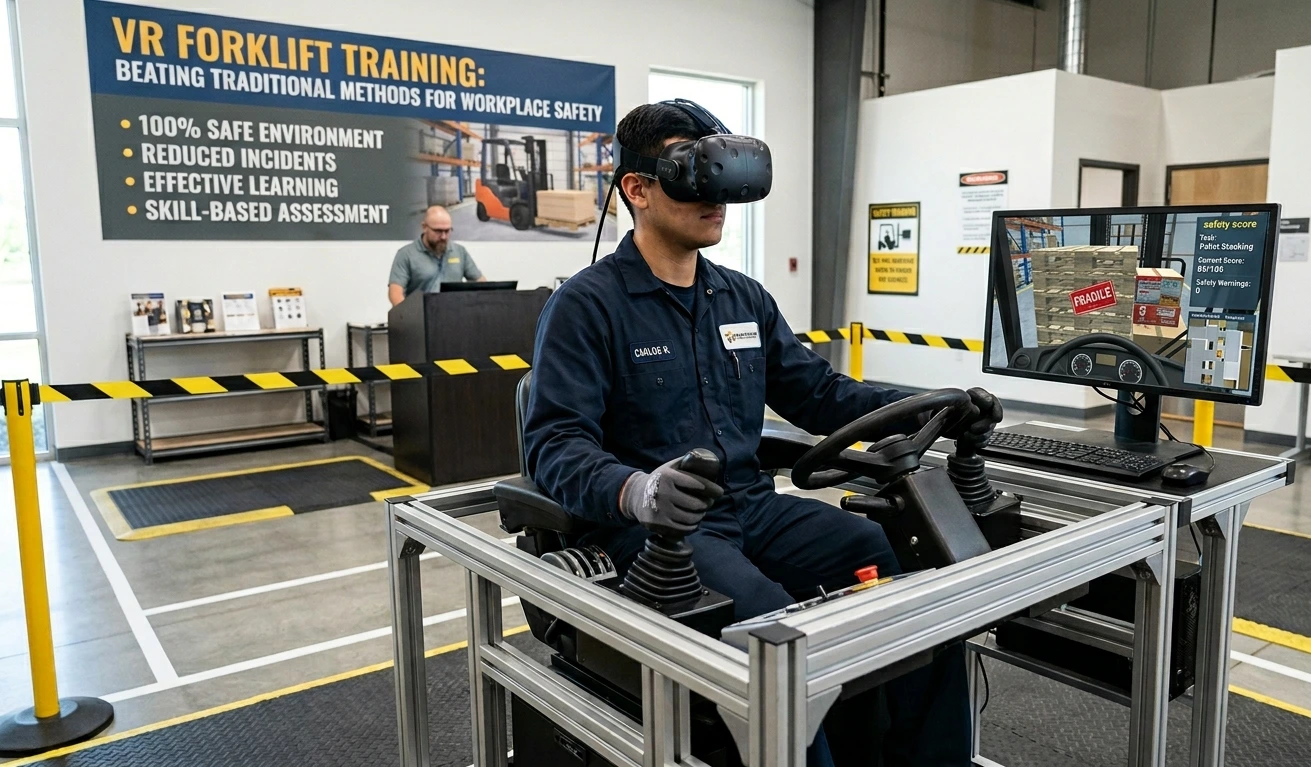
The simulation provides visual and sensory feedback for different loading scenarios, maneuvering in tight spaces and using forklift controls without the risks of incorrect operation.
Reduces Liability for Industrial Facilities
Companies face legal and financial exposure when operators lack proper preparation. OSHA estimates that around 70% of forklift incidents could be prevented with better training and safety practices. Employers who put operators behind the wheel without adequate preparation expose themselves to regulatory penalties, insurance claims and legal risk. OSHA fines for non-compliance can reach up to $135,532.
Training programs that work can reduce operator errors by up to 70 percent. Companies that implement simulator-based training programs report reducing incident rates by 20 to 35 percent within 12 months. This translates to millions of dollars in avoided workers' compensation claims and productivity losses. Operators who demonstrate competency in simulation before touching real equipment represent lower risk.
Allows Practice of High-Risk Scenarios Without Consequences
VR forklift training makes repeated practice of dangerous situations possible that would be too risky to rehearse with actual equipment. Trainees encounter common warehouse hazards: pallets falling into aisles, spills appearing on floors, workers emerging from blind corners. They practice appropriate responses sounding the horn, slowing down, taking alternate routes and build reflexes and situational awareness.
The simulation has challenging maneuvers that often lead to accidents: stacking pallets at height, reversing with limited visibility and navigating blind intersections. Operators repeat high-risk scenarios dozens of times in a single session, something impossible with live equipment. This environment allows trainees to experience tip-over dynamics, load shifting, emergency braking and blind spot navigation while building the muscle memory and decision-making patterns needed for safe operation before they ever enter the warehouse floor.
Cost Advantages of Virtual Training Systems Over Traditional Methods
Financial considerations fuel adoption decisions in industrial facilities, and VR forklift training delivers measurable cost advantages that traditional methods cannot match. We've watched clients at TrainBeyond move from skepticism to advocacy once they get into the actual numbers behind virtual training systems.
Lower Equipment and Maintenance Expenses
Companies that train operators on actual forklifts must remove equipment from production schedules. This creates lost throughput and rental costs for backup units during instruction cycles. VR simulators enable parallel training of multiple cohorts using a single hardware station, reducing per-trainee instruction costs by 40 to 50 percent compared to traditional on-the-job training methodologies. Organizations operating around the clock can schedule simulator sessions during shift transitions without disrupting material flow and improve overall equipment effectiveness.
The financial case becomes compelling when you look at long-term returns. Forklift VR simulator installations achieve ROI within 18 to 36 months through reduced equipment damage, lower incident-related workers compensation costs and decreased downtime associated with traditional on-equipment training. Organizations training 100 to 200 operators each year report average savings of $400,000 to $600,000 annually from reduced accidents, equipment damage and training downtime, compared to simulator installation costs of $150,000 to $400,000 based on configuration.
Larger training centers managing 300 or more operators achieve even faster payback periods of 12 to 18 months as hardware costs amortize across higher training volumes. Extended operational lifespans of 7 to 10 years support ongoing positive cash flow. Once a virtual training system runs, the marginal cost of training each additional operator drops substantially. No extra fuel consumption occurs and no additional wear on forklifts accumulates. One instructor handles multiple trainees or allows solo practice.
Cost comparisons reveal the scale of savings. Traditional classroom methods combined with live demonstrations cost $150,000 to $250,000 each year for facilities managing 500 employees. VR training requires $30,000 to $60,000 one-time investment or $12,000 to $36,000 each year for subscription models. Research shows VR training reaches cost parity with classroom methods at around 375 employees. Facilities running 500 or more workers across multiple shifts see favorable returns in year one under perpetual-license models, and the gap widens each subsequent year.
Reduced Facility Space Requirements
Physical space represents another hidden expense in traditional training programs. A Virtual Reality Buck offers an affordable solution that can be located almost anywhere and keeps valuable trucks in operation. Stationary equipment allows operator instruction without the need for large, dedicated teaching areas. TrainBeyond's clients in distribution centers have converted former training bays into productive warehouse space because simulator stations have a compact footprint.
Decreased Insurance Costs
Insurance carriers recognize the risk reduction virtual training provides. Companies implementing simulator-based programs experience measurably lower incident rates. This translates to reduced workers' compensation claims and contributes to lower insurance premiums. The cost of training mishaps drops to zero in a virtual environment and creates a compelling financial case that addresses why operational expenses occur rather than patching problems.
How VR Training Improves Skill Development and Retention
Skill acquisition speed and knowledge retention determine how quickly operators become productive assets. VR forklift training accelerates learning while embedding safer operational habits that persist long after certification.
Real-Time Performance Feedback and Correction
Training systems track every action and deliver instant feedback during each session. The system flags mistakes the moment an operator makes them, allowing correction on the spot. This immediate response loop is fundamentally different from traditional instruction where errors might go unnoticed until an instructor reviews performance later. The simulation tracks fork tilt angle, load centering, approach speed, and stack placement accuracy. Safety debriefs trigger when operators drop loads or exceed rated capacity. Performance reports cover pre-inspection completion, speed compliance, load handling accuracy, hazard response time, and pedestrian awareness. TrainBeyond's virtual training system logs every decision and captures reaction times, inspection completion, and hazard recognition as objective data.
Repeatable Practice Until Mastery
Operators repeat high-risk scenarios dozens of times in a single session, something impossible with live equipment. Students practice new skills at their own pace and repeat lessons or specific skills as many times as needed until they feel confident and proficient. VR learners complete training 4x faster than classroom-only learners. Operators who practice emergency stops and pedestrian encounters 20 times in VR respond faster than operators who watched a video once. Trainees become ready for real-forklift testing and warehouse work after a couple of hours.
Muscle Memory Development Through Simulation
Immersive learning techniques through VR accelerate learning through muscle memory, which improves operator confidence. The system builds the physical responses that keep operators safe on the live floor. Operators receive ongoing instruction and real-time feedback in simulated warehousing environments and build skill sets that emphasize safe behaviors and consistent performance. VR prepares operators by allowing them to build core competency and muscle memory in zero-risk simulators before touching actual equipment. The simulation builds muscle memory so trainees practice dangerous scenarios in virtual environments, something that cannot be done in the real world.
Higher Engagement Levels Than Classroom Learning
Trainees remain active rather than passive instead of sitting in classrooms watching slides. The immersive nature keeps operators competing against their own scores, reacting to real-time challenges, and building greater confidence with every completed session. Gamification keeps people engaged, and having fun while learning specific skills goes a long way. Studies show substantial increases in learning retention rates when incorporating virtual reality compared to traditional learning methods. An independent study at Central Washington University found 100% of participants reported VR training increased comprehension and substantially improves 30-day knowledge retention.
Customized Learning Pace for Each Operator
VR forklift training accommodates everyone from complete beginners to seasoned operators refreshing their skills. Adaptable difficulty and adjustable learning pace ensure each trainee receives appropriate challenges, making training effective and inclusive across experience levels. Raymond's guided lessons increase in complexity and build upon principles learned in earlier lessons, providing operators with consistent experiences while reinforcing desired behaviors.
Realistic Scenario Training for Industrial Environments
Modern VR forklift training replicates the exact environments operators encounter daily. TrainBeyond's virtual training system goes beyond generic warehouse simulations by creating industry-specific scenarios that mirror actual working conditions.
Warehouse-Specific Simulations
Users enter simulated warehousing environments on real Raymond forklift trucks or bucks. The software has multiple lift truck models and allows quick switches between different forklifts in your fleet. Each model comes with guided lessons that increase in complexity and build upon principles learned in earlier sessions. Operators practice pallet movement, aisle navigation, loading operations and rack handling in controlled virtual spaces. The simulation throws common warehouse surprises at trainees: a pallet falls into the aisle, a spill appears on the floor, or a worker walks out from a blind corner. These exercises sharpen reflexes and situational awareness.
Manufacturing Floor Conditions
Manufacturing environments need different skills than warehousing operations. VR platforms recreate production-floor logistics, material transfer between stations and assembly-line handling scenarios. Three distinct scenarios based on actual SCA Packaging factory locations reflect true operational tasks and maneuvers such as loading waste paper bales and handling paper reels. This facility-specific approach improves training relevance by matching the exact conditions operators face.
Distribution Center Challenges
Training programs adjust to address specific industry needs. Operators handling delicate goods in pharmaceutical warehouses require different preparation than those managing pallets in large distribution centers. VR training allows this variety of settings and ensures operators practice the precise material handling their roles demand. Broome-Tioga Workforce New York partnered with SUNY Broome and BOCES to develop an educational program using Raymond's Virtual Reality Simulator, allowing participants to enter simulated warehousing environments on actual Raymond forklifts.
Low-Light and Crowded Workspace Scenarios
Operators experience diverse conditions such as low light or crowded work environments in preparation for actual operation. These challenging scenarios prepare workers for environments one would not want to recreate in real life and build confidence before they face these conditions on the floor.
Implementing VR Forklift Training in Your Industrial Facility
Deploying VR forklift training at your facility needs minimal infrastructure. TrainBeyond guides industrial clients through optimized implementation that gets operators training within days, not months.
Required Equipment and Technology
A Meta Quest headset represents the baseline requirement, priced between $300 and $500 per unit. These standalone devices need no PC, cables, or external sensors. TrainBeyond ships headsets pre-configured with training software loaded and reduces setup to minutes rather than hours. One headset trains unlimited operators over its lifespan.
Hardware configurations scale to match facility needs. Portable desktop simulators pack the VR experience into mobile kits with steering wheel consoles and pedals that fit on tables. VR buck units provide stationary mock-ups with real forklift controls and replicate different configurations without tying up functional vehicles. Full motion setups with force-feedback platforms deliver ultra-realistic training for precision-critical operations.
Most deployments become operational within 10 to 14 business days. The system works offline and air-gapped for facilities with network restrictions.
Integration with Existing Training Programs
VR satisfies the performance evaluation and training components of OSHA 1910.178(l). Pair virtual instruction with qualified evaluator sign-off on actual equipment to meet certification requirements. Trainers must know how to interpret VR performance metrics and configure systems. Start with one truck class and one facility before organization-wide rollout.
Tracking and Measuring Training Outcomes
The virtual training system exports SCORM-compliant completion data compatible with major LMS platforms including Workday Learning, Cornerstone OnDemand, and SAP SuccessFactors. Performance reports document pre-inspection completion, speed compliance, load handling accuracy, hazard response time, and pedestrian awareness. Supervisors receive PDF documentation for OSHA audits and generate timestamped completion records per trainee exactly as compliance audits require.
Conclusion
VR forklift training represents a practical investment for industrial facilities serious about operator safety and cost reduction. Virtual training systems eliminate physical risks while cutting training expenses by 40 to 50 percent compared to traditional methods. The technology delivers ROI within 18 to 36 months when you factor in faster skill development and measurable incident reduction.
Industrial clients at TrainBeyond have changed their safety culture through simulation-based training. Operators arrive on the warehouse floor better prepared and more confident. The implementation process takes days rather than months. This makes the technology available for facilities of any size. Your next cohort of certified operators could start their training tomorrow.
FAQs
VR training provides realistic, hands-on practice in a virtual environment that accelerates skill development. Trainees can repeat scenarios multiple times without risk, building muscle memory and confidence more quickly. Studies show VR learners complete training 4 times faster than classroom-only learners, with significantly improved 30-day knowledge retention rates.
VR training eliminates all physical risks associated with learning on actual equipment. Trainees can practice dangerous scenarios like tip-overs, emergency stops, and navigating crowded spaces without any possibility of injury, equipment damage, or accidents. This zero-risk environment allows operators to make mistakes and learn from them safely before ever operating real forklifts.
Forklift accidents cause nearly 100,000 injuries and over 200 fatalities annually in the United States. Without adequate training, operators risk serious incidents including tip-overs, falls from platforms, crushing injuries, and striking pedestrians. Proper training can reduce operator errors by up to 70 percent and prevent the majority of forklift-related accidents.
VR creates realistic simulations that allow employees to experience and respond to dangerous situations without actual consequences. Instead of imagining difficult scenarios, trainees practice in immersive environments that replicate real workplace hazards from falling pallets to blind corners building the reflexes and decision-making skills needed for safe operation.
VR training reduces per-trainee instruction costs by 40 to 50 percent compared to traditional methods. Organizations training 100 to 200 operators annually report average savings of $400,000 to $600,000 from reduced accidents, equipment damage, and training downtime. Most facilities achieve ROI within 18 to 36 months, with larger operations seeing payback in as little as 12 months.