

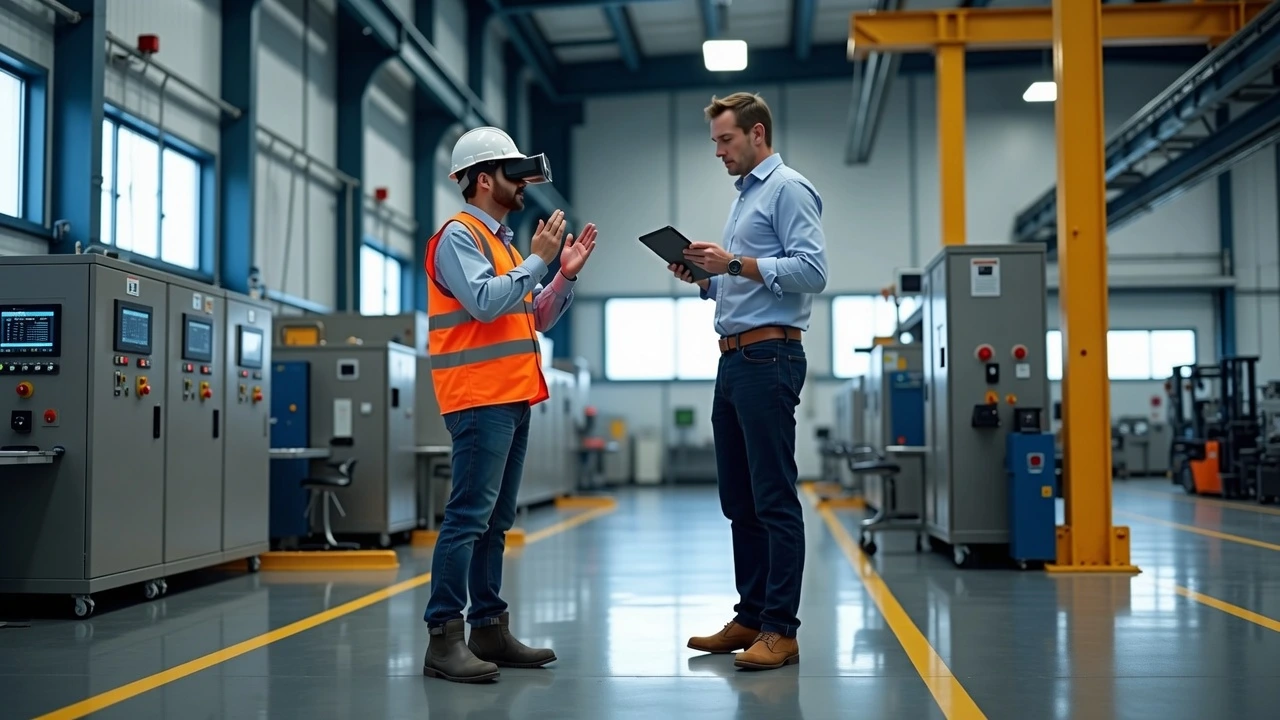
Virtual reality training has proven that learners master skills 4 times faster and feel 275% more confident applying them compared to traditional classroom methods. These aren’t theoretical gains; industrial sectors are experiencing measurable improvements in safety and efficiency through immersive training environments.
TrainBeyond has seen how VR training solutions transform industrial workforce development. Virtual simulations eliminate ground risks while accelerating competency development, from manufacturing floor operations to hazardous equipment handling. Industries like oil and gas, automotive, and logistics are leveraging this technology to train teams at multiple locations with consistent, measurable results.
This piece will explain what virtual reality training means for industrial applications, detail the concrete benefits we’re seeing, and share proven use cases that deliver ROI.
What is Virtual Reality Training for Industrial Applications
Virtual reality training in industrial contexts means workers wear VR headsets and step into full-scale simulations that replicate their actual facilities, equipment and operating conditions. We build these environments at TrainBeyond using real engineering data, CAD models and layout drawings converted into optimized 3D formats for interaction. The objective isn’t visualization; it’s preparedness.
Immersive Training Environments Explained
Immersive training environments fully disconnect users from the physical world and place them inside a 3D digital space. Workers interact with virtual replicas of equipment, tools and workspaces that mirror their real job sites. This is different by a lot from watching videos or clicking through slides. Trainees grip tools, read gages and respond to changing conditions within the simulation. The interactive nature promotes hands-on learning and builds muscle memory through considered practice.
These environments can display entire facilities or equipment that wouldn’t physically fit in a training room. Workers walk through digital twins of plants to identify hazards, practice exit routes and follow safety procedures. VR creates a controlled setting where high-stakes tasks like handling toxic chemicals or confined space entry can be rehearsed down to the last detail, with zero real-life danger.
How VR Training Simulates Real-life Industrial Scenarios
Industrial VR training scenarios are structured around procedural logic and approved standard operating procedures. Users follow the same sequence of actions, interlocks and decision paths required in actual operations. The environment responds to their actions, allowing them to see cause and effect immediately.
Trainees can practice routine equipment startups, steady-state monitoring and system adjustments to build familiarity. VR excels at simulating abnormal situations like pressure changes, alarms or equipment malfunctions that are difficult to practice safely in live environments. Workers can rehearse emergency shutdowns, lockout-tagout procedures and critical transitions repeatedly until correct actions become instinctive. Made a mistake? The simulation resets with no production downtime or damaged equipment.
Key Technologies Behind Industrial VR Training Solutions
Modern VR training runs on standalone headsets like Meta Quest 3, HTC Vive and Varjo XR-4 that deliver high-resolution visuals and precise motion tracking. A 2024 study found that 83% of trainees felt VR headsets helped them become skilled at real equipment faster. Haptic feedback systems add physical sensations, allowing workers to feel vibrations or resistance when interacting with virtual objects.
AI-driven simulation engines adjust scenarios based on user actions and make each session personalized. These systems track decision paths, timing and responses to identify patterns like hesitation during alarms. Some platforms sync with industrial control systems like PLCs or SCADA, letting workers practice using the exact logic they’ll encounter on the job. Cloud-based deployment allows businesses to roll out training remotely without extensive hardware investments.
Real Benefits of VR Training in Industrial Sectors
Industrial operations just need training methods that reduce risk while accelerating competency. Virtual reality training delivers both, backed by metrics that prove its effectiveness across safety, speed, cost, scalability, and measurement.
Workplace Safety Risks Eliminated
Workers can experience high-risk scenarios like confined space entry, working at height, and emergency evacuations without exposure to actual dangers. VR training in mining operations reduced lost time injuries by 43%, while industrial rollouts have decreased safety incidents by 35-50% through hazard rehearsal. TrainBeyond’s operators practice equipment malfunctions and fire response procedures until correct actions become automatic. This risk-free repetition builds confidence and muscle memory that translates to safer real-life performance.
Faster Skill Development and Reduced Training Time
VR learners complete training four times faster than classroom methods. What takes two hours in a classroom can be learned in 30 minutes using VR. Workers reach role competency 40-60% faster with VR onboarding compared to traditional approaches. Pfizer reduced new task training time by up to 40% during vaccine production scaling, and United Rentals cut safety training time by 40% for construction site sales representatives.
Scalable Training at Locations of all Types
VR modules replicate across sites without quality degradation once developed. Adding the 500th learner costs approximately the same as adding the fifth. Immersive training will give consistent learning outcomes across contractors and geographies, reducing variability in safety practices.
Measurable Performance Tracking and Data Analytics
VR captures over 100 data points per second, including attention patterns, decision-making sequences, and procedural deviations. Performance data provides objective competency evidence rather than attendance records. Digital records create stronger audit trails than traditional methods.
Industrial Use Cases That Work
Proven implementations in six industrial sectors demonstrate where VR training solutions deliver the strongest returns. TrainBeyond has deployed virtual reality training programs that address the specific challenges each industry faces.
Manufacturing and Assembly Line Training
Honda’s East Liberty Auto Plant trained over 1,500 associates with VR for the Acura MDX assembly process and completed training before physical production began. Ford reported 30% savings in pre-manufacturing costs through VR prototyping and training. Boeing reduced assembly training time by 25% with VR simulations for complex wiring tasks.
Electrical Safety and Hazard Recognition
VR electrical training enables workers to practice lockout-tagout procedures and arc flash boundary determination without exposure to live electricity. Training modules based on OSHA guidelines cover PPE selection and emergency response protocols.
Heavy Equipment Operation Training
VR reduces heavy equipment training time. Operators practice in virtual job sites before touching physical machinery. Trainees become skilled at forklift operation and excavator controls in risk-free environments.
Oil And Gas Industry Procedures
Oil and gas operations use VR to simulate confined space entry and emergency shutdowns. Workers practice protocols for gas leaks and equipment failures that cannot be safely recreated in live drills.
Warehouse And Logistics Operations
DHL achieved 99% trainee satisfaction with VR package handling training. UPS reduced driver training time from 8 hours to 2 hours while maintaining quality standards. DB Schenker cut forklift training time by 30% with VR simulations.
Automotive Industry Applications
Volkswagen trained over 10,000 employees in assembly and customer service with VR. BMW developed VR training covering workplace planning and qualification. Ford reduced shop floor injuries by 70% after analyzing VR training data to improve assembly processes.
How TrainBeyond Implements VR Training Solutions
At TrainBeyond, our implementation approach starts with technical requirements and ends with measurable business outcomes.
The Right VR Hardware for Industrial Needs
We deploy standalone headsets that eliminate tethered PC requirements and cable management problems. These devices deliver high-resolution displays with motion tracking while remaining portable enough for multi-site deployment. Battery life and durability matter in industrial settings, so we select hardware built for repeated daily use rather than consumer-grade options.
Custom Industrial Training Scenarios
TrainBeyond builds custom modules using client-provided CAD models, facility layouts and standard operating procedures. Our platform supports digital twin integration and allows workers to train on virtual replicas of their actual equipment. No-code authoring tools let your subject matter experts update training content without developer assistance. This reduces modification costs by 50-70% compared to traditional development approaches.
Integration with Existing Safety Protocols
Our VR training solutions integrate with SCORM-compatible learning management systems and support xAPI data standards for tracking. Training records flow into your existing compliance documentation systems. Browser-based deployment options eliminate dedicated IT infrastructure requirements while maintaining data encryption standards.
ROI And Training Effectiveness Measurement
TrainBeyond captures procedural accuracy, completion rates and decision-making patterns during each session. This data demonstrates training effects through reduced incident rates, faster onboarding cycles and improved audit readiness.
Conclusion
Virtual reality training delivers results that matter for industrial operations: safer workers and faster competency development with measurable cost reductions. Companies in manufacturing, oil and gas, logistics, and automotive sectors are experiencing transformable workforce outcomes through immersive learning.
We built TrainBeyond to address the specific challenges industrial teams face. You make an investment that pays returns through reduced incidents and accelerated onboarding at the time you implement VR training with custom scenarios and performance tracking. Training quality remains consistent at facilities of all types.
FAQS

Workers complete VR training four times faster than traditional classroom methods. What typically takes two hours in a classroom setting can be learned in just 30 minutes using virtual reality. Additionally, workers reach full role competency 40-60% faster with VR onboarding compared to conventional training approaches.
Yes, VR training significantly improves workplace safety. Mining operations using VR training experienced a 43% reduction in lost time injuries, while industrial implementations have shown 35-50% decreases in safety incidents. Workers can practice high-risk scenarios like confined space entry, emergency evacuations, and equipment malfunctions repeatedly in a risk-free environment until correct responses become automatic.
VR training systems capture over 100 data points per second, including attention patterns, decision-making sequences, procedural deviations, completion rates, time-to-competency, and procedural accuracy. This detailed performance data provides objective evidence of competency rather than just attendance records, creating stronger audit trails and enabling targeted improvements.
Multiple industries have achieved proven results with VR training. Manufacturing companies like Honda trained over 1,500 associates and Ford saved 30% in pre-manufacturing costs. Logistics companies like DHL achieved 99% trainee satisfaction, while UPS reduced driver training time from 8 to 2 hours. Automotive manufacturers including Volkswagen trained over 10,000 employees, and Ford reduced shop floor injuries by 70% using VR training insights.

