

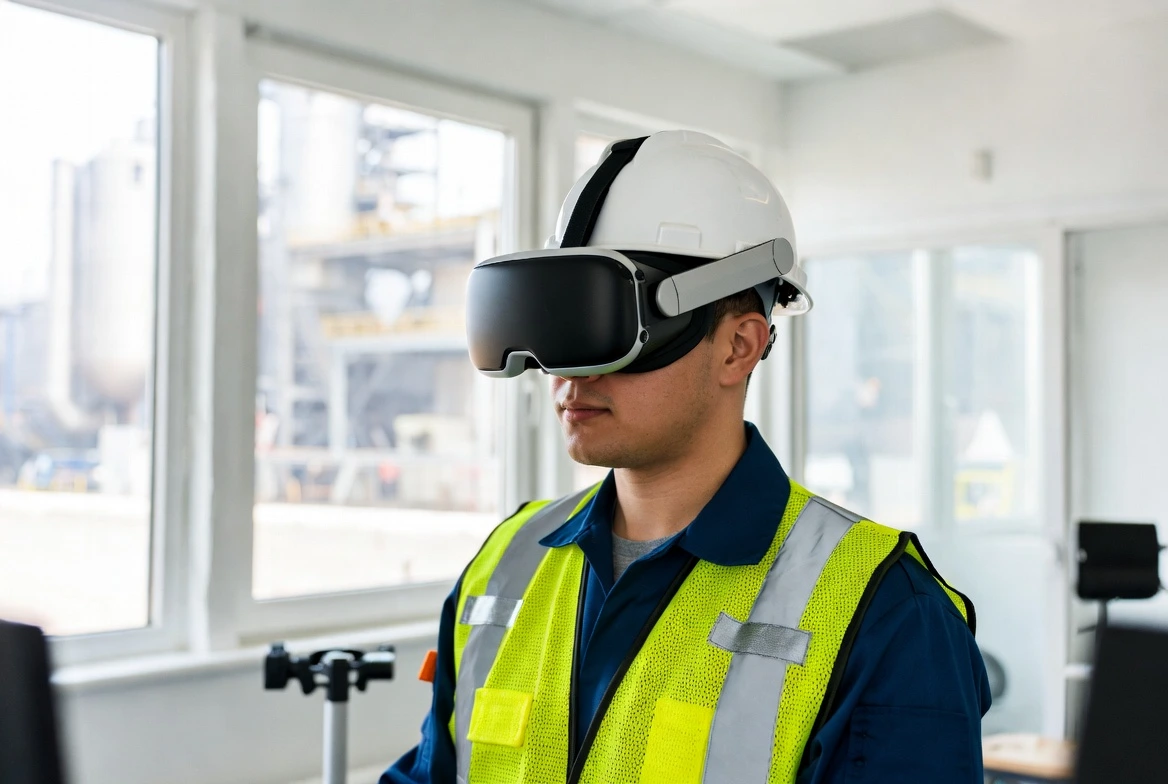
VR safety training is changing how industrial organizations protect their workforce from hazardous scenarios without exposing them to ground danger. Traditional safety training approaches face persistent challenges like low involvement, limited realism, and inconsistent delivery across sites. Research shows that immersive learning leads to higher knowledge retention than traditional methods. Virtual reality safety training addresses these gaps by providing risk-free, hands-on experience in realistic environments.
This piece will walk you through what VR safety training is and the key benefits for industrial sectors. You’ll learn how to implement it in your organization. We’ll also share ground success stories from companies like TrainBeyond that are creating safer workplaces.
What is Virtual Reality Safety Training and Why It Matters
Defining VR Safety Training for Industrial Workplaces
VR safety training goes way beyond workers wearing headsets. The technology includes fully immersive headset-based experiences, projection-based immersive rooms, large interactive screens, simulated spaces, and 360° images or videos that employees can explore on desktops, tablets, or smartphones. The defining feature isn’t the hardware but the level of immersion and interactivity that enables learners to engage with realistic environments in ways that boost understanding, retention, and safe decision-making.
Workers put on headsets and practice in digital environments that mirror their actual workplaces. Whether you’re training operators on heavy machinery or preparing teams for confined space entry, VR creates experiences that feel authentic. Companies like TrainBeyond design these simulations to match specific industrial hazards and allow employees to build competence before stepping into real danger zones.
The Limitations of Traditional Safety Training Methods
Traditional safety training approaches struggle with several persistent challenges:
- Low engagement: Passive learning methods like slide decks and videos fail to hold attention and reduce knowledge retention.
- Limited realism: Employees are asked to imagine hazardous environments rather than experience them.
- Inconsistent delivery: Training quality varies depending on the instructor, location, or time constraints.
- Risk during training: Workers in some sectors face real hazards before they’re fully prepared.
Safety training that fails to reflect actual working conditions leaves employees understanding procedures in theory but struggling to apply them under pressure. This gap between knowledge and action contributes to workplace accidents and fatalities.
Why Organizations Are Switching to VR Training
The move to virtual reality safety training is driven by measurable results. 51% of companies are either integrating VR into strategy or have already built it into at least one line of business. Companies save between 50% to 70% when replacing instructor-led training with electronic content delivery.
VR-trained employees demonstrate up to 275% more confidence to act on what they learned after training. They’re also up to four times more focused during training than their e-learning peers and 1.5 times more focused than classroom colleagues. A 2022 study in the mining industry found a 43% drop in injury-related downtime after VR safety training.
The cost effectiveness becomes clear at scale. At 375 learners, VR training achieved cost parity with classroom learning. At 3,000 learners, it became 52% more cost-effective. Industrial organizations are adopting VR not as an experimental technology but as a proven method to build safer workplaces.
Key Benefits of VR Safety Training for Industrial Sectors
“A study conducted by PwC found that VR training can improve employee performance by up to 70% compared to traditional training methods.” — PwC, Professional services network
Risk-Free Exposure to Hazardous Scenarios
Workers can practice handling chemical spills, electrical hazards and equipment failures without physical danger. TrainBeyond creates simulations where employees encounter sparking electrical panels, collapsing structures or high-pressure system failures. Mistakes become learning opportunities rather than costly accidents. Trainees experience realistic consequences in the virtual environment and build hazard recognition skills that translate to real-life situations.
Improved Knowledge Retention and Muscle Memory
VR safety training achieves 75% knowledge retention compared to 5% from lectures and 10% from reading. The immersive nature engages behavioral learning systems through physical repetitions and immediate corrective feedback. Workers practice lockout/tagout procedures or emergency responses repeatedly until movements become automatic. This repetition converts knowledge into reflex, which holds up under stress when split-second decisions matter.
Faster Onboarding for High-Risk Roles
New hires reach competency in 5-8 weeks with VR training versus the traditional 10-12 week timeline. This results in a 19% productivity increase within one month. Employees practice real tasks in risk-free environments using digital twins of actual equipment until steps become consistent. This reduces first-time exposure anxiety and builds confidence before workers handle live equipment or enter hazardous zones.
Consistent Training Quality at Multiple Sites
VR delivers similar training experiences whatever the location and eliminates the variability that occurs with different instructors. Every worker in Toronto or Texas receives the same scenarios, hazards and evaluation criteria. TrainBeyond’s platforms ensure standardized competency baselines for distributed workforces, which proves invaluable for audits and maintaining safety protocols.
Cost Savings Through Reduced Incidents
Intel documented a 300% five-year ROI from VR electrical safety training. Tyson Foods achieved over 20% reduction in injuries and illnesses, while DHL reported 100% reduction in lost time due to injury and 32% fewer near misses. VR safety training reduces workplace injuries by 20-33% compared to traditional methods.
How to Implement VR Safety Training in Your Organization
Looking at Your Current Safety Training Needs
A training needs analysis identifies gaps between what your employees can do now and the skills they need for safe operations. Conduct a Hazard Identification and Risk Assessment (HIRA) first to determine workplace hazards that pose risks to workers. This systematic approach involves looking at job functions and reviewing incident reports. You’ll also analyze near-miss data and assess current competency levels through work observations or skills tests.
Map your training requirements by categorizing needs into universal skills like simple safety protocols, industry-specific procedures such as sector regulations and standard equipment operation, and organization-specific processes including proprietary workflows and custom equipment. This analysis will help you identify which scenarios benefit most from VR safety training versus traditional methods.
Choosing the Right VR Training Platform
Assess platforms based on content ownership, device compatibility, offline capability and analytics depth. Can you create and edit your own scenarios, or are you locked into a fixed library? Platforms like TrainBeyond and EXP360 let you build custom 360°, VR and XR experiences of all types, combining content flexibility with multi-channel delivery. Field and factory locations rarely have reliable connectivity. Offline playback becomes essential.
Creating Realistic Training Scenarios for Your Industry
Custom VR development timelines range from 8-24 weeks depending on scope. Simple scenarios with linear narratives cost USD 25,000-50,000. Complex simulations with branching paths and physics engines range from USD 75,000-250,000. TrainBeyond can customize modules in days or build new ones in weeks.
Integrating VR Training with Existing Safety Programs
Choose one high-impact scenario first rather than attempting everything at once. Modern VR headsets require minimal space, roughly 2m x 2m per trainee, plus a charging station. Your existing safety team becomes VR facilitators after learning headset setup and performance data debriefing procedures.
Industry Applications and Real-World Success Stories
“100% better – my concentration lapses after about 10 seconds in a classroom, so this really kept me focused.” — VR Site Safe Learner, Participant in VR training
Manufacturing and Heavy Machinery Operations
BMW uses VR to train employees on factory setup, lean manufacturing principles and proper work procedures. Peugeot employs VR to teach ergonomic work postures. Heavy equipment operators practice with forklifts, excavators and loaders in virtual environments before touching actual machinery. This reduces equipment wear and eliminates fuel costs during training.
Construction and Working at Heights
TrainBeyond addresses the construction industry’s fatal four hazards: falls, being struck by objects, electrocutions and caught-in/between incidents. Workers practice fall protection, harness inspection and scaffolding safety in immersive scenarios that replicate actual jobsite conditions. Physical risk is eliminated.
Oil and Gas Operations
Harbor Energy has used VR technology for over four years to improve major accident hazard awareness. The company showcases jet fires, diesel pool fires and natural gas explosions from DNV’s testing facility. Shell and ExxonMobil use VR simulations to train employees throughout the oil and gas value chain, from rigs and pipelines to refineries.
Chemical Processing and Hazardous Materials
HazVR provides virtual platforms for hazmat instructors and students to practice air monitoring at simulated incident sites. The platform visualizes typically invisible gases with realistic meter responses. First responders accumulate accelerated experience and increase preparedness while reducing exposure risks.
TrainBeyond Success Stories in Industrial Settings
TrainBeyond’s immersive platform is built to scale across diverse industrial verticals. As a testament to this flexibility, their solutions have successfully deployed virtual training for high-risk environments, ranging from emergency drills in the oil and gas sector to assembly line safety in manufacturing. No matter the industry, TrainBeyond specializes in translating complex operational procedures into risk-free, customized VR scenarios that substantially reduce workplace accidents.
Conclusion
Virtual reality safety training represents a proven investment in workforce protection rather than an experimental technology. Companies like TrainBeyond demonstrate that immersive training delivers measurable results: fewer accidents and better retention in industrial sectors of all types.
Assess your specific hazards before you implement VR training and identify which scenarios benefit most from immersive practice. Choose platforms that offer customization flexibility and start with one high-impact use case. You’ll build a safer workplace while reducing incident-related costs if you do this correctly.
FAQS

VR safety training uses immersive headsets or interactive screens to simulate realistic digital workplaces. It allows workers to practice handling dangerous situations like chemical spills or machinery operations building critical muscle memory and competence without any real-world risk.
Organizations see a significant return on investment by drastically reducing workplace accidents and onboarding times. By replacing expensive, high-risk physical simulations with reusable digital content, companies cut delivery costs by 50-70% and achieve higher cost-efficiency than standard classrooms.
Yes. Studies show a 20-33% decrease in workplace injuries compared to traditional methods. For example, Tyson Foods reduced injuries by over 20%, DHL achieved a 100% reduction in lost time due to injury, and mining companies saw a 43% drop in injury-related downtime.
VR training cuts onboarding time nearly in half. New hires reach operational competency in just 5–8 weeks compared to the traditional 10–12 week timeline, leading to a 19% productivity increase within the first month.
VR safety training is particularly valuable in high-risk industrial sectors including manufacturing (heavy machinery operations), construction (working at heights, fall protection), oil and gas (emergency response, equipment operations), and chemical processing (hazardous materials handling). Companies like BMW, Shell, ExxonMobil, and Harbor Energy have successfully implemented VR training to address industry-specific hazards and improve worker safety across their operations.

