

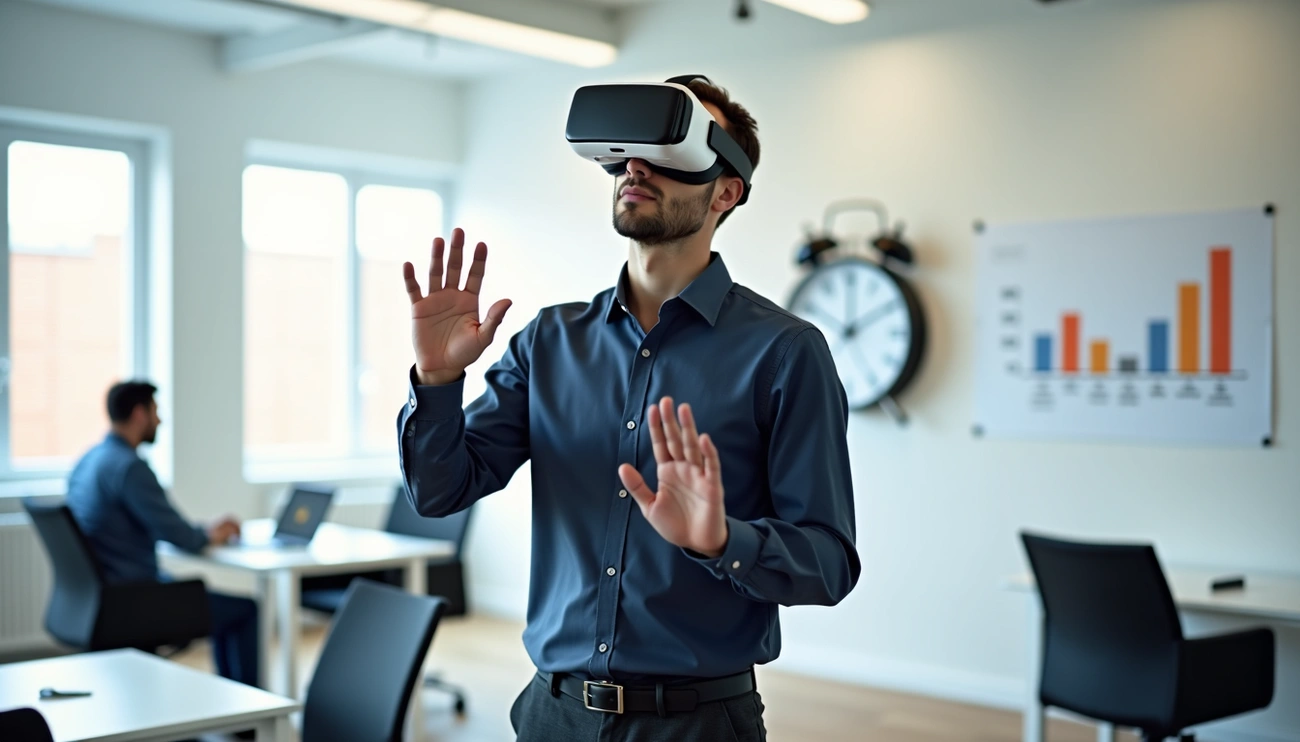
Understanding Virtual Session Duration For Training Environments
Standard Session Length Overview
A complete virtual training session in TrainBeyond typically lasts between 45 and 60 minutes, taking into account the full user experience.This duration is designed to maintain high levels of attention and effectiveness, whether you are training healthcare professionals on surgical procedures or manufacturing employees on safety protocols.
To achieve an optimal session, we recommend structuring it into four main phases:
- Arrival and Check-in: Participants join 10 minutes before the official start time. This period is used to verify connection, audio, video, and access to the TrainBeyond platform.
- Technical Preparation: 10 to 15 minutes for equipment fitting (VR Headset, controllers, etc.) and a brief orientation or tutorial inside the virtual environment.
- Core Immersive Training: The main training session lasts between 30 and 40 minutes, which falls within the research-backed optimal range for immersive learning.
- Debrief and Review: The final 10 minutes are dedicated to discussion, Q&A, and reviewing key moments from the experience.
This structure ensures the immersive training portion stays within the ideal attention span while allowing sufficient time for proper setup and meaningful closure.
How Long Does Virtual Training Session Last In Professional Settings
In professional training environments, session length is highly flexible and can be customized according to the training objectives. While the core immersive VR experience is optimally designed to last 30-40 minutes (the duration backed by research for best engagement and minimal fatigue), organizations can easily build longer training blocks by combining multiple VR modules with breaks and complementary activities.
This modular approach allows companies to create extended training sessions of 90 minutes to 2 hours when needed particularly for complex skills that require repeated practice. A typical longer block might include:
- Multiple 30-40 minute immersive VR modules
- Breaks between sessions
- Theoretical explanations, seminars, or group debriefings
- Q&A and performance review
Some studies also indicate that experienced VR users, with high-quality hardware and well-optimized content, can comfortably engage in immersive sessions of up to 55-70 minutes. However, 30-40 minutes remains the recommended standard for the core VR training to ensure maximum learning retention and user comfort. This flexible structure gives trainers the ability to respect the ideal immersive duration while still delivering the longer, comprehensive training programs that many professional scenarios require.
Factors That Influence Session Timing
Session duration in training environments depends on several variables. Hardware quality plays the most important role, as current headsets weighing about half a kilogram can cause physical discomfort during extended use. Fresnel lenses in some models contribute to eye strain over longer periods.
User familiarity matters a lot. Research indicates that targeting 45 minutes works as students become familiar with VR, with longer durations becoming viable as experience increases. Training complexity also dictates timing needs. Sessions focused on engagement peak during 10-20 minute windows. After that, fatigue reduces retention.
Motion sickness remains a concern with artificial locomotion and limits what users can tolerate. Organizations must balance these physical constraints against training objectives when scheduling VR sessions.
The Science Behind Optimal VR Training Sessions
Meta’s Research On The 20-40 Minute Sweet Spot
Meta identified the 20-40 minute range as the best duration for VR sessions through behavioral observations and research into when users end sessions. Sessions below 15-20 minutes create an extreme drop-off in enjoyment because users view them as less satisfying than 20+ minute experiences. The friction of clearing physical space and donning equipment requires sessions to deliver enough progress and entertainment to verify that upfront investment.
Sessions exceeding 40 minutes force users to choose between quitting mid-task or pushing past comfort levels. Meta found that most sessions stay under 40 minutes, with longer durations reserved for special occasions rather than regular use. Current form factor limitations, including headset weight around half a kilogram and eye strain from optics, mean that a majority of users either can’t or don’t want to exceed 40 minutes. But Meta recommends 10-20 minute gameplay loops within that 20-40 minute window and allows trainees to complete at least one satisfying cycle before choosing whether to continue.
Academic Findings From Longitudinal Studies
A 15-week study tracking VR class sessions found that benefits for peer social presence and perceived competence began declining after 45 minutes of VR duration. Research suggests keeping VR duration around 30 minutes for comfort and engagement in educational contexts. But some studies show maximum durations of 55-70 minutes work for high-quality hardware running efficient software with familiarized users.
Mixed reality research identified 15-20 minutes as best, especially for users with little prior experience. The study showed that VR/MR activity duration has a decisive influence on fatigue outcomes, with users identifying 15-20 minutes as best despite mild symptoms emerging.
Physical And Cognitive Fatigue Thresholds
Virtual Reality training is highly immersive, which makes it very effective — but it can also lead to faster mental and physical fatigue compared to traditional training methods if not properly managed. At TrainBeyond, we design our sessions with this reality in mind. That is why we recommend core immersive sessions of 30-40 minutes, a duration that maximizes learning while staying within comfortable cognitive and physical thresholds for most users. Proper session design is key to preventing fatigue. By structuring training with:
- Optimal immersive durations
- Strategic breaks between modules
- Clear debriefing periods
We help organizations maintain high levels of concentration, motivation, and performance throughout the training. Our approach acknowledges the natural fatigue thresholds of VR while leveraging its strengths: deeper engagement, better knowledge retention, and more effective skill transfer all without compromising user wellbeing.
Why Session Length Affects Learning Outcomes
Extended VR exposure influences performance and learning retention because fatigue affects concentration and motivation. Class time in VR relates in a linear way with instructor and peer social presence as well as perceived competence. But engagement benefits plateau and decline after the 45-minute threshold for most users. Targeting 45 minutes as students familiarize themselves with VR, then encouraging longer durations as comfort increases, optimizes learning outcomes while managing fatigue.
Maximizing Training Effectiveness Within VR Time Constraints
Building Modular Training Loops
Rather than creating long continuous experiences, many organizations achieve better results by designing training in short, focused 8-10 minute AI-powered roleplay modules that learners can complete in succession. This modular approach is particularly effective because: Most employees interact with VR training apps infrequently, so shorter modules accommodate limited continuous attention spans.
- Simpler interactions within each module improve completion rates and knowledge retention.
- Clear start-and-finish flows provide learners with easy on-ramps and meaningful recaps at the end of each segment.
- Training developers benefit from reusable components (“prefabs”) that ensure consistency across different modules and scenarios.
By breaking complex training into well-designed 8-10 minute loops, organizations can maintain high engagement while building deeper skills progressively without overwhelming the learner.
Incorporating Natural Break Points
Users adjust to VR environments better when duration and intensity increase over time. Medical training scenarios incorporate restart mechanisms. Learners can repeat simulations until they achieve successful patient treatment outcomes. Mistakes turn into safe, memorable learning experiences without compromising involvement.
Balancing Involvement With Comfort Levels
At TrainBeyond, we carefully balance deep immersion with user comfort to ensure effective and enjoyable training experiences. We design training scenarios with sessions typically ranging from 15 to 30 minutes, while minimizing excessive head movement to help reduce the risk of motion sickness. Strategic breaks are built in to address any technical issues or sensory overload when necessary. To maintain motivation and prevent frustration, we incorporate clear feedback mechanisms along with visual and auditory rewards that guide learners through complex challenges. This thoughtful approach allows participants to stay fully engaged while maintaining a comfortable and positive training experience.
Live Performance Tracking During Sessions
VR data enables tailored learning pathways by tracking time spent on tasks, error rates, and decision-making processes. Custom metrics provide application-specific performance insights during development. Analytics capture session duration, content completion rates, and repeat usage patterns. Operators can optimize training based on actual behavior.
Industry-Specific Considerations For VR Session Planning
Different industries apply VR session timing based on specific training needs and safety requirements.
Healthcare And Medical Training Requirements
Virtual Reality is transforming medical education and training by allowing healthcare professionals to practice critical skills in highly realistic, risk-free environments. Through VR simulations, medical teams can repeatedly practice complex surgical procedures, emergency responses, and patient communication before working with real patients. This repetitive, hands-on practice builds muscle memory and confidence in a safe setting.Leading medical schools, such as Stanford and Harvard, have already integrated VR into their curricula. In these immersive environments, students and professionals can experience rare medical procedures multiple times, while emergency room scenarios recreate high-pressure situations where nurses and doctors must manage multiple challenges simultaneously. The result is better-prepared medical professionals who can make critical decisions with greater confidence all without risking patient safety.
Manufacturing And Safety Simulation Needs
Industrial training sessions run 45 minutes for occupational safety programs. Boeing reduced training time by 75% using VR for complex wiring and assembly tasks. Ford employs VR to teach safer production line procedures and ergonomic techniques. Safety training modules are structured as 15-20 minute full courses, with shorter 7-10 minute sprint courses and 3-5 minute simulation-only modules. Manufacturing companies report up to 75% reduction in training time for equipment operation and maintenance.
Corporate Onboarding And Skill Development
Virtual Reality is delivering dramatic efficiency gains in corporate training.Leading companies have achieved impressive results:
- Walmart reduced new technology training from 8 hours to just 15 minutes a 96% reduction.
- Verizon shortened customer de-escalation training from 10 hours to 30 minutes.
- Sprouts Farmers Market compressed new hire onboarding from 4 hours to 45 minutes, an 81% reduction.
Adapting Session Length To Training Complexity
The optimal duration of a VR training session depends on the complexity of the skills being taught.
Simpler tasks, such as hazard identification, work well in shorter 15 to 20-minute sessions. More complex procedural training, on the other hand, requires the full 30 to 45-minute range to ensure proper skill development and competency.
This flexible approach allows organizations to tailor session length according to their specific training objectives, achieving the best balance between efficiency and learning effectiveness.
Conclusion
The 20-40 minute sweet spot goes beyond a simple guideline for VR training sessions. Organizations that respect these limits backed by science see better learning outcomes and higher employee involvement. You might train surgeons, onboard warehouse staff or develop leadership skills. What matters most is designing modular experiences with break points that feel natural. Structure your training programs around these optimal durations. Your teams will retain more and experience less discomfort.
FAQs

A complete virtual training session typically lasts 45-60 minutes from start to finish. This includes 10 minutes for user onboarding and system verification, 10-15 minutes for equipment fitting and the virtual tutorial, 30-40 minutes for the core immersive simulation, and approximately 10 minutes for the post-session performance review and data analysis.
Research shows that sessions shorter than 20 minutes deliver low engagement due to the logistical effort required for equipment setup, while sessions exceeding 40 minutes push users past their physical and cognitive comfort levels. This timeframe balances active participation with factors like headset weight, eye strain, and mental fatigue to optimize learning outcomes.
Yes, organizations can structure multiple consecutive modules to create 90-minute to two-hour training blocks. This approach works well for complex operational skills that require repeated practice cycles, ensuring strategic breaks are incorporated between sessions to manage fatigue and allow for structured debriefing.
Studies show that knowledge transfer and focus begin declining after 45 minutes of continuous VR exposure. Prolonged simulation time causes physical and cognitive fatigue that impacts concentration, motivation, and professional performance, ultimately reducing overall learning retention.
For users with little prior VR experience, a 15-20 minute simulation window is optimal to minimize initial fatigue and motion sickness. As personnel become familiar with VR technology, sessions can gradually extend to 45-55 minutes, with certain experienced users managing up to 70 minutes when leveraging high-quality hardware and fully optimized systems.

